


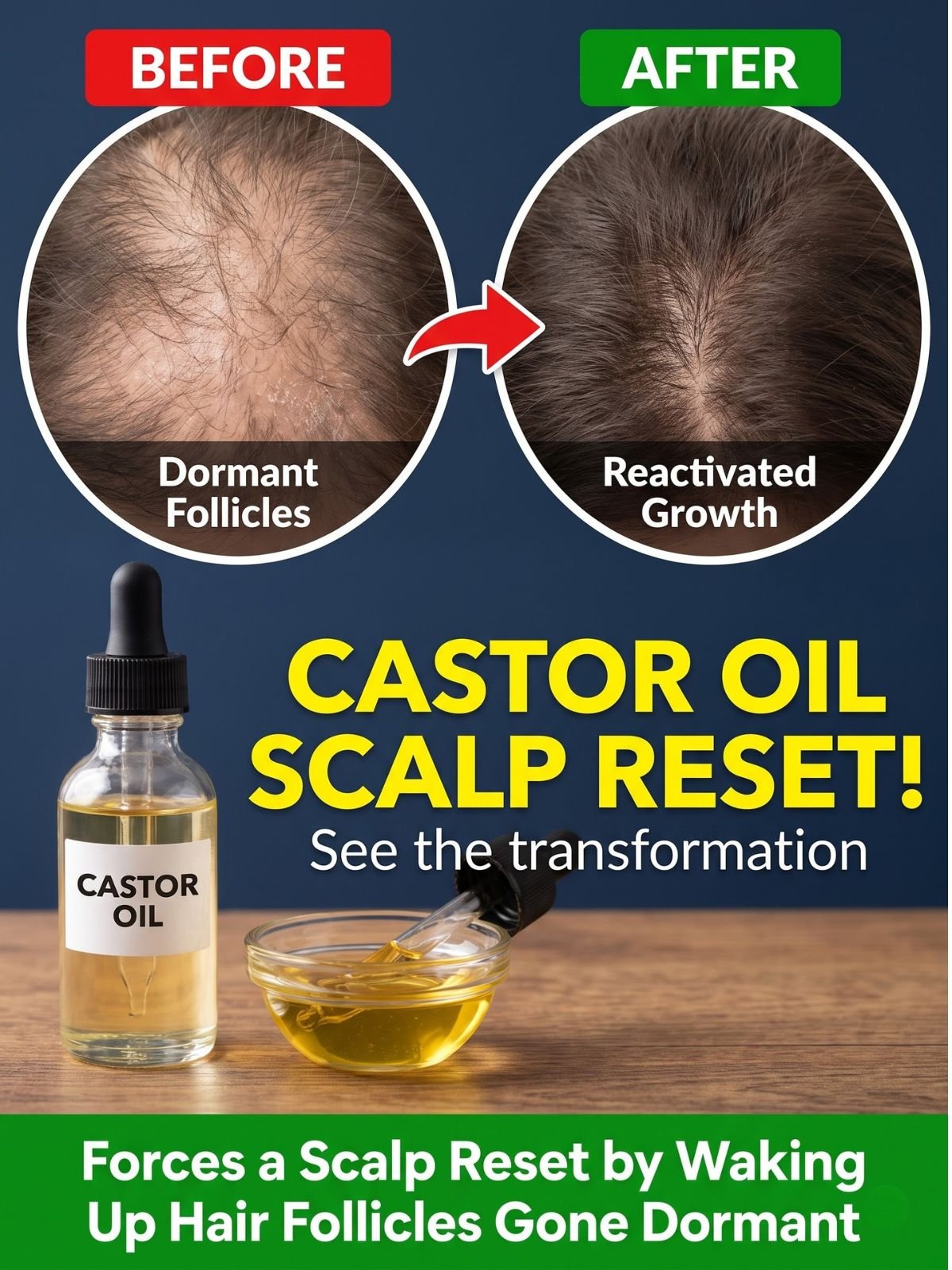
Castor oil doesn’t behave like an ordinary hair oil. Thick almost to the point of stubbornness, thick enough to cling to a comb, it carries something most bottles on a drugstore shelf don’t: ricinoleic acid, a fatty acid with real anti-inflammatory and antimicrobial properties that most people slathering it on have never actually heard named.
That matters more than it sounds like it should, because an itchy, flaky, or quietly inflamed scalp is one of the more overlooked reasons hair can thin, shed more than usual, or simply stop growing at the rate it used to. A scalp under low-grade stress doesn’t support hair the way a calm one does.
What castor oil changes isn’t the shine on your strands. It’s the condition of the ground those strands are actually growing out of.
The Follicle Environment Nobody Checks
Call it the Follicle Reset — not a chemical that forces new hair to appear, but a shift in the environment follicles are sitting in. Hair doesn’t grow well out of scalp skin that’s dry, flaky, or quietly inflamed, the same way a plant struggles in compacted, nutrient-starved soil.
Picture a garden bed that’s gone hard and cracked from lack of water. Seeds are still down there, technically alive, but nothing pushes through cracked, starved soil the way it would through soil that’s soft, moist, and cared for. A dry, irritated scalp treats hair follicles the same way — not dead, just sitting in ground that isn’t supporting them.
Ricinoleic acid’s anti-inflammatory effect, combined with castor oil’s heavy, occlusive moisture, can calm that irritation and lock in hydration the scalp was otherwise losing. That’s the actual mechanism — not summoning follicles from nowhere, but making the ground they’re already in more livable.
But there’s a second piece to this that has nothing to do with the oil itself.
Why the Massage Might Matter as Much as the Oil
Applying castor oil almost always means rubbing it into the scalp with the fingertips for several minutes, and that motion isn’t incidental — scalp massage on its own has been shown in small studies to modestly improve local circulation and even influence hair thickness over time, independent of what oil is used.
Think of it like unclogging a small stream that’s slowed to a trickle. The water was never gone, it just wasn’t reaching the far end of the bed. A few minutes of firm, circular pressure across the scalp does something similar for blood flow to the follicles sitting there.
No shampoo brand builds a marketing campaign around “rub your own scalp for five minutes a day” — there’s no product to sell in that instruction, so it rarely gets said out loud, even though it may be doing as much work as anything in the bottle.
What Castor Oil Actually Can’t Do
Here’s the part that matters most, and it’s the part most castor oil posts skip entirely: there is no strong clinical evidence that castor oil regrows hair lost to androgenetic alopecia (the genetic pattern hair loss affecting both men and women) or reverses significant, patterned thinning. What evidence exists is mostly about scalp condition and hair shaft strength, not about resurrecting follicles that have permanently miniaturized.
If hair loss is patchy, sudden, or clearly progressing along a genetic pattern — a receding hairline, a widening part, a thinning crown — that calls for a dermatologist, not a bottle from the pantry. Treatments with actual clinical evidence behind them (like minoxidil) exist for a reason.
Where Men and Women Tend to Notice a Difference
Men often notice it first as less visible flaking and a scalp that feels calmer under a cap or after a workout. Women often notice it first in the strands themselves — less breakage at the hairline, a texture that feels less brittle by the ends.
Different entry points, same underlying shift: a scalp that’s stopped fighting dryness and irritation on its own.
The One Habit That Wastes the Whole Bottle
Washing it out with a single shampoo pass. Castor oil is thick enough that one rinse rarely removes it fully, and the leftover residue can weigh hair down and make it look greasy rather than nourished — which is usually the moment people give up on it, convinced it “doesn’t work” or “just makes hair worse.”
What actually works:
- Apply to the scalp only, not the full length, unless hair is very dry
- Leave it on for at least an hour, or overnight under a shower cap
- Shampoo twice, working the second wash specifically into the roots
- Once or twice a week is enough — daily use mostly just adds cleanup, not benefit
P.S. Castor oil is often mixed with a lighter carrier oil to make it easier to wash out and spread more evenly across the scalp — which oil it’s paired with changes both how well it rinses and how much it actually penetrates. That pairing is worth getting right before writing off the whole routine.
This article is for informational purposes only and does not replace professional medical advice. Patch test on your inner arm before applying to the scalp, as castor oil can cause allergic reactions in some people. If you’re experiencing sudden, patchy, or rapidly progressing hair loss, see a dermatologist — this can be a sign of an underlying condition that needs proper diagnosis.